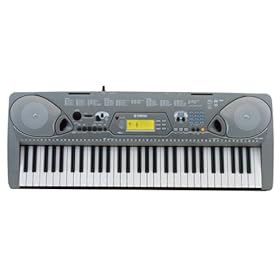

This review is from: Yamaha EZ-250i Portatone Lighted Musical KeyboardWe got this keyboard just before Christmas 2003. Due to the pace of daily life, I haven't gotten too deeply into it. But since it has been several months and no one else has reviewed it, I'll start the ball rolling. The reason why I purchased THIS keyboard because it has a touch sensitive (velocity) and lighted keyboard. The only other model that fit this description was the Casio LK-55. I just thought the Yamaha sounded a bit better and was made a bit better. It is also more expensive. The sounds are quite good. There is an XG lite implementation as well as the standard General Midi soundset. The lighted keys make it easy to learn. I have been too busy to hook it up to my computer yet to try out the downloading of General Midi sequences, but I am looking forward to it. The supplied USB cable is too short unless your keyboard is right up against your computer. I was disappointed to find out that the only MIDI implementation is through a USB interface. There are no midi in and out jacks, so I couldn't hook this up directly to my other MIDI keyboard. I'd love for Yamaha to come out with a version that had regular Midi jacks, pitch and mod wheels and an audio input (with reverb) for sing alongs. I'd pay double the price for those additions. For what you pay, I'd say you get your money's worth and then some.UPDATE DECEMBER 2004We've now had this keyboard about a year. Since my initial review, I've solved the computer problems that kept me from loading the software that came with the computer. (The problem was in my computer, and not in the Yamaha keyboard.)I love the sound-filer software. This software allows you to load general midi files from the computer to the keyboard. The built-in flash memory on the keyboard will hold about 10 new songs, give or take. You can remove them and replace them at will with the songfiler software. Once loaded into the Ez-250i, the sequences play back just as the built-in songs do, lights and all, but with one exception, you can choose which instrument sounds are assigned to the left and right hand regions of the keyboard. This allows you to learn any of the orchestral parts of the song, and to see any of the parts assigned to the lighted area of the keyboard. The software also allows you to use the EZ-250i as a midi slave instrument to play back sequences played by your computer's midi player or sequencer. This means the EZ-250i will play back any of the midi files you have stored on the computer without having those files actually loaded into the flash memory of the EZ-250i. In my experience, most songs sound better played by the Yamaha keyboard than the computer's Microsoft general midi instruments. I'm not that thrilled with the Konami game that came with the computer. It seems like a Japanese home market game that doesn't translate well to American audiences. My kids aren't even that interested in it. I had no problems getting it going though.Since my earlier review, I've explored the depths of the sound engine. There is a lot of synthesis horsepower under the surface. There is dynamic digital filtering on the voices, something you don't see on el-cheapo keyboards. In addition, the keyboard can split and layer voices, giving you up to four distinct sounds playable from the keyboard at any given time. The sound engine responds well over midi to pitch-bend and even portamento (gliding from note to note). It's a shame there's no pitch-bend wheel or portamento switch for live playing. Since my earlier review, Casio has come out with a new lighted keyboard, the LK-90TV, that competes directly with the Yamaha EZ-250i. I haven't seen this personally, but it has some interesting features. It has a TV output to display Karaoke lyrics from sounds loaded by the user. It also accepts smartmedia cards for user-loaded sounds, though, as I understand it, this is a read-only slot. In other words, you can't load the card with sounds while hooked up to your keyboard. The card must be loaded from a reader attached to the computer. Though I haven't heard it live, it appears the sound-engine is the same as the LK-55, which, to my ears, sounded distinctly inferior to the Yamaha's. In summary, a year after my purchase, I'm happy with my purchase, and I'd make the same choice today. I think Yamaha should add the lighted keyboard feature to its upmarket products, including keyboards with microphone inputs, pitch & mod wheels and sound editing features....
This review is from: Yamaha EZ-250i Portatone Lighted Musical KeyboardThe Pros: After a decade since its creation, the Yamaha's proprietary soundset of XG MIDI (Extended General Musical Instrument Interface) is still unmatched in quality of sound and its versatility. As all Yamaha products are, it seems well-built, sturdy, reliable. The Cons: No 64-bit drivers available. Old USB v. 1.1 connection (at least on my unit. I would expect them to change that into the 2.0 eventually). Comes with no dust cover, which is an essential accessory. Part of these keyboards are packaged without an AC adapter. Included (and boasted shamelessly) Konami Piano learning software is incompatible with Windows XP. It installs well, but crashes when launched. Konami CSR said this version of software is for distribution in Europe only, so they don't support it in the USA. When I objected that I've purchased it from Amazon.com in the U.S., as a part of new, full retail Yamaha unit, they said it's an outdated software and they don't support it anyway. Translation: Konami piano learning software is a piece of junk, if you have Windows XP)....
This review is from: Yamaha EZ-250i Portatone Lighted Musical KeyboardI have been tracking this product in a number of forums. Re a newer driver, it appears that one can be downloaded from the yamaha.com website (http://www.yamaha.com/yamahavgn/CDA/ContentDetail/ModelSeriesDetail/0,,C...

Detail Products
Detail Reviews
Click here for more information

»»»Visit Store NOW...
Best price click here
