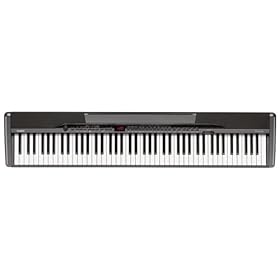

This review is from: Casio PX-320 Privia Digital PianoI have played the Casio PX-320 for a couple weeks and am a beginner/intermediate piano player. The PX-320 keys have texture and shape and pressure and volume range and return speed that invites making music. The PX-320 is scaled (graded) so that treble notes are easier and quicker versus bass notes are harder and slower. The keys are weighted and have a simulated hammer action. For my taste the keyboard is a joy to play and is close to an acoustic piano. I think the Yamaha YPG-635 and Yamaha P85 have at least as good touch and piano sound. I liked the Yamaha YPG-635 display and controls and features and sounds. The YPG-635 is too wide to lay flat in my car while the PX-320 lays on my back seat or back floorboard. The PX-320 base is flat and as large as the top, unlike the P85 that has a base smaller than the top. The P85 has 10 voices. The PX-320 weighs 26 lbs (12kg). The PX-320 has 11 one-touch sounds like grand piano, electric piano, organ, strings and synth-voice. The PX-320 has 60 wide ranging Casio voices. The PX-320 has 128 General MIDI (GM) voices and 2 Drum Sets. I am pleased with the variety and quality of the voices. I like the large 3-character display and miss a numeric keypad and graphic display. The speakers are fine for a bedroom or living room. If the recessed screws underneath the back are loose the speakers can cause plenty of subtle or annoying noise. I like the Casio PX-320 price, car fit, finger action, voices, 5 song recording or playback with as little as 2 key pushes, and usable speakers. I look forward to exploring 2-track recording, quick registration, 70 play-along rhythms, and flash memory slot. The Casio PX-320 is enjoyable to play and delightful to hear and easy to learn....
This review is from: Casio PX-320 Privia Digital PianoI have a px-320 and a yamaha p-85 sitting right next to each other. I couldn't decide which to get so I got both and plan on returning one of them. I'm not a concert pianist, but I've played many pianos in my time, and I can honestly say that both of them feel, gloriously, like real pianos. And if you're going to try them out, you have to do it with the sound on - contrary to intuition, the feel of a piano is very much dependent on its sound.It was a hard decision, but ultimately I decided on keeping the Casio, the main reason being because it gave me a greater library of sounds and output options. However, they are both excellent products as they feel and sound like real pianos. I've spent some time at the stores trying keyboards out and nothing comes close to Casio or Yamaha in the same price range. The Yamaha feels a tad better IMO and has a tad more dynamic range, but playing the Yamaha through its speakers, it sounded too bass-ey and muddled. I don't like the idea that I only have two piano sounds to choose from when the Casio has a number of them, plus ways to brighten or darken the tone. Plus, the Casio's speakers just sound better. I actually think I could play at a low-key place with the Casio's speakers, where the Yamaha's speakers are just worthless. The keys on the Casio are a tad harder to push, and that makes it harder to play softly and limits the dynamic range. Also, sometimes there are bizarre tonality issues, like the some keys sound just a little off tune - but I can't nail this down as they seem completely fine at other times. But unless you're super anal, this probably won't be an issue. Overall, I'd say the Yamaha is more dark and the Casio is more bright.Ultimately I went with the Casio because the only good sound on the Yamaha is the piano while the Casio has a wealth of decent stuff. I don't want to get stuck with a dark piano tone when I'm looking for something else. One other thing...it annoys me that the p-85 only has stereo 1/4" outs - meaning you have to split its stereo out into two lines. That's just not right on a keyboard I'm spending so much money on. The Casio has two 1/4" Ins and Outs. It might be silly and overkill, but that makes me happy - like Casio is taking me seriously....
This review is from: Casio PX-320 Privia Digital PianoFor the price paid, the Casio Privia PX-320 delivers much more than the products from competitors. See the description.The multiple voices provided sound ok through the speakers, but they sound better through a decent pair of headphones.I bought mine to replace a Yamaha P-120, that was too heavy to carry around.I consider the action of the Casio to be very close of the Yamaha's in terms of quality - even if they feel different.Out of the box I would say that the Casio action feels lighter and more dynamic - it is not good or bad, as it is a question of taste.I have no issue going back to my Yamaha C3 grand piano after I practiced on the Casio. That is what matters to me.The PX comes with a lot of additional voices that are actually, for many but not all, quite usable. The piano allows to layer 2 voices and to set the volume of each of them. You can even add a 3rd voice if split the keyboard. 128 polyphony allows to play without the PX-320 to drop notes, even during sustained phrases.A the PX-320 offer a lot of settings, check out the doc (online on the Casio website) to feel your confort with its interface.It takes some time to get what you want but you can store your settings in the 96 registration slots for instant setting retrieval. A must that lacks the PX-200. In addition the drum sets are dynamic (sound soft or loud depending on your strike speed) and that allows very decent drum play and midi edition.Over all a great DP that delivers way more - it would even be a perfect Midi studio controller if it would come with the usual modulation and pitch bend wheels.Time for me to get back to it and play my preferred classical pieces. BTW, it comes with the 60 classical pieces score book that the PX-320 has in memory. Very nice....

Detail Products
Detail Reviews
Click here for more information

»»»Visit Store NOW...
Best price click here
